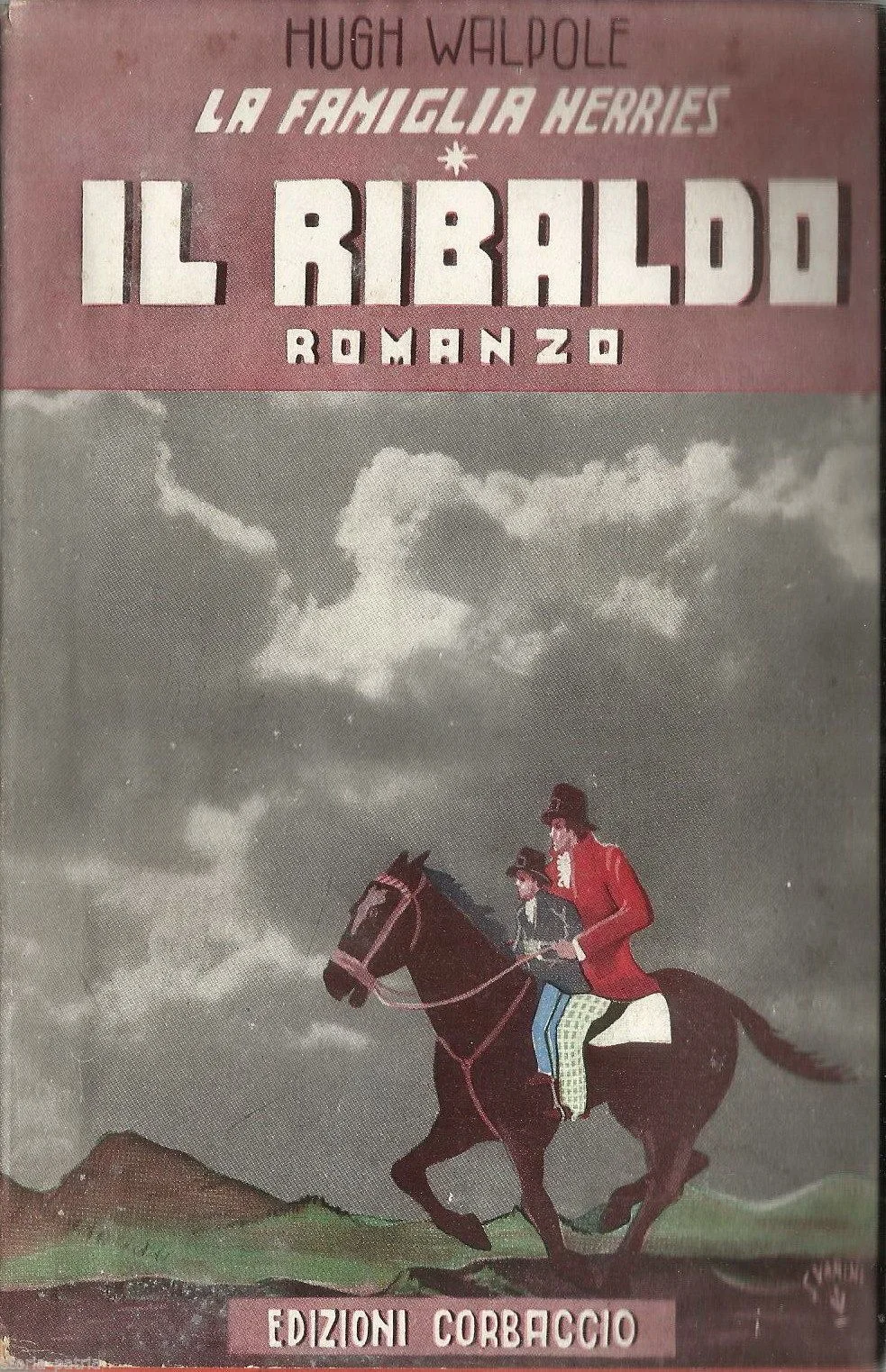
Vanessa Di Hugh Walpole Edizione Corbaccio 1939 Copertina Vanini

Valore stimato —108.5

Descrizione

HUGH WALPOLE LA FAMIGLIA HERRIES VANESSA Milano, Corbaccio, 1939 Cm. 19,5; pp. 606; bross. edit. con sovraccopertina figurata. Interessante antica edizione d'epoca, grosso volume con il romanzo del noto scrittore inglese curato da Bianca Ugo; *l'opera è suddivisa in quattro parti, in cui troviamo capitoli su:* *IL MASCALZONE* *IL MARITO* *L'AMANTE* *LO SPETTRO*  c*on bella sovraccopertina illustrata a cura dell'artista Vanini.*  . DI INTERESSE CULTURALE, LETTERARIO, BIBLIOGRAFICO Buona conservazione generale, segni o difetti d'uso o d'epoca, usuali sparse fioriture o difetti vari marginali, difetti marginali alla brossura, ma esemplare mai sfogliato, ancora a fogli chiusi. *(l'immagine allegata raffigura un particolare della copertina anteriore, eventuali ulteriori informazioni a richiesta)* ###### ### *From Wikipedia, the free encyclopedia* [](https://en.wikipedia.org/wiki/File:Hwalpole.jpg)[*![](https://en.wikipedia.org/skins-1.5/common/images/magnify-clip.png)*](https://en.wikipedia.org/wiki/File:Hwalpole.jpg "Enlarge")*Sir Hugh Walpole, photographed by Carl Van Vechten, 1934* ***Sir Hugh Seymour Walpole** (13 March 1884 – 1 June 1941) was an English* [*novelist*](https://en.wikipedia.org/wiki/Novel "Novel")*. A prolific writer, he published thirty-six novels, five volumes of short stories, two plays and three volumes of memoirs. His skill at scene-setting, his vivid plots, his high profile as a lecturer and his driving ambition brought him a large readership in the United Kingdom and North America. A best-selling author in the 1920s and 1930s, his works have been neglected since his death.* *Walpole was born in* [*Auckland*](https://en.wikipedia.org/wiki/Auckland "Auckland")*, New Zealand, the eldest of three children of the Rev George Henry Somerset Walpole (1854–1929),* [*Canon*](https://en.wikipedia.org/wiki/Canon_\(priest\) "Canon (priest)") *of St Mary's Cathedral, Auckland (later* [*Bishop*](https://en.wikipedia.org/wiki/Bishop "Bishop") *of* [*Edinburgh*](https://en.wikipedia.org/wiki/Edinburgh "Edinburgh") *from 1910 to 1929) and his wife, Mildred Helen née Barham (1854–1925).[\[1\]](https://en.wikipedia.org/wiki/Hugh_Walpole#cite_note-dnb-0) Walpole was educated at a series of boarding schools in England, principally at* [*Truro School*](https://en.wikipedia.org/wiki/Truro_School "Truro School") *for two years,* [*the King's School, Canterbury*](https://en.wikipedia.org/wiki/The_King%27s_School,_Canterbury "The King's School, Canterbury") *for two years and as a day boy for four years at* [*Durham School*](https://en.wikipedia.org/wiki/Durham_School "Durham School") *, when his father was principal of* [*Bede College*](https://en.wikipedia.org/wiki/Bede_College "Bede College") *at the university. Walpole's popular character Jeremy lived in the cathedral town of Polchester in Glebeshire, an amalgam of Truro and Durham, which featured in many of his later books. The dust-jacket of The Inquisitor (1935) depicted a street map of this imaginary town. Walpole's brief experience of teaching is reflected in his third novel Mr Perrin and Mr Traill.* *Walpole attended* [*Emmanuel College, Cambridge*](https://en.wikipedia.org/wiki/Emmanuel_College,_Cambridge "Emmanuel College, Cambridge") *[\[2\]](https://en.wikipedia.org/wiki/Hugh_Walpole#cite_note-gale-1) Walpole's father hoped that his son would follow him into the* [*clergy*](https://en.wikipedia.org/wiki/Clergy "Clergy")*, but after working between 1906 and 1909 as a lay missioner at the* [*Mersey*](https://en.wikipedia.org/wiki/Mersey "Mersey") [*Mission to Seamen*](https://en.wikipedia.org/wiki/The_Mission_to_Seafarers "The Mission to Seafarers") *in* [*Liverpool*](https://en.wikipedia.org/wiki/Liverpool "Liverpool")*, and as a teacher, Walpole took up writing as his career.[\[2\]](https://en.wikipedia.org/wiki/Hugh_Walpole#cite_note-gale-1)* ### *Literary career* *Walpole's first novel, The Wooden Horse (1909), received good reviews but barely repaid the cost of having it typed.[\[1\]](https://en.wikipedia.org/wiki/Hugh_Walpole#cite_note-dnb-0)[\[2\]](https://en.wikipedia.org/wiki/Hugh_Walpole#cite_note-gale-1) His first commercial success was Mr. Perrin and Mr. Traill, published in 1911. The young Walpole cultivated relationships with successful senior writers, and received encouragement from* [*A. C. Benson*](https://en.wikipedia.org/wiki/A._C._Benson "A. C. Benson")*,* [*Henry James*](https://en.wikipedia.org/wiki/Henry_James "Henry James")*,* [*Joseph Conrad*](https://en.wikipedia.org/wiki/Joseph_Conrad "Joseph Conrad") *and* [*Arnold Bennett*](https://en.wikipedia.org/wiki/Arnold_Bennett "Arnold Bennett")*.[\[1\]](https://en.wikipedia.org/wiki/Hugh_Walpole#cite_note-dnb-0)* [*![](https://upload.wikimedia.org/wikipedia/en/thumb/0/09/Hugh_walpole_1909.jpg/175px-Hugh_walpole_1909.jpg)*](https://en.wikipedia.org/wiki/File:Hugh_walpole_1909.jpg)[*![](https://en.wikipedia.org/skins-1.5/common/images/magnify-clip.png)*](https://en.wikipedia.org/wiki/File:Hugh_walpole_1909.jpg "Enlarge")*Walpole in 1909* *Ineligible for military service in* [*World War I*](https://en.wikipedia.org/wiki/World_War_I "World War I") *because of poor eyesight, Walpole worked in Russia, first for the* [*Red Cross*](https://en.wikipedia.org/wiki/Red_Cross "Red Cross")*, winning the Georgian Medal for rescuing a wounded soldier under fire,[\[3\]](https://en.wikipedia.org/wiki/Hugh_Walpole#cite_note-times-2) and later as head of the Anglo-Russian Propaganda Bureau during the* [*Russian Revolution*](https://en.wikipedia.org/wiki/Russian_Revolution_\(1917\) "Russian Revolution (1917)")*. He drew on this experience for The Dark Forest (1916) and The Secret City (1919).[\[1\]](https://en.wikipedia.org/wiki/Hugh_Walpole#cite_note-dnb-0) The latter was joint winner of the inaugural* [*James Tait Black Memorial Prize*](https://en.wikipedia.org/wiki/James_Tait_Black_Memorial_Prize "James Tait Black Memorial Prize")*.[\[4\]](https://en.wikipedia.org/wiki/Hugh_Walpole#cite_note-3)* *After the war, Walpole resumed his prolific writing regime. His novels of the 1920s included The Cathedral (1922), a novel of ecclesiastical machinations; and Wintersmoon (1928), illustrating the clash between traditionalism and modernism: his own sympathies, though not spelled out, were clearly with the traditionalists.[\[5\]](https://en.wikipedia.org/wiki/Hugh_Walpole#cite_note-4)* *In 1930 Walpole began his most popular series of novels with his historical romance Rogue Herries set in* [*Cumberland*](https://en.wikipedia.org/wiki/Cumberland "Cumberland") *in the mid-eighteenth century. This was followed by Judith Paris (1931), The Fortress (1932) and Vanessa (1933), which brought the saga up to the twentieth century. Walpole said of the Herries series, "It carries the English novel no whit further, but it sustains the traditions and has vitality."[\[6\]](https://en.wikipedia.org/wiki/Hugh_Walpole#cite_note-5)* *In addition to writing, Walpole frequently lectured on literary subjects. He was a fluent speaker, much in demand, and commanded high fees both in Britain and in America.[\[7\]](https://en.wikipedia.org/wiki/Hugh_Walpole#cite_note-6)* ### *\[*[*edit*](https://en.wikipedia.org/w/index.php?title=Hugh_Walpole&action=edit§ion=4 "Edit section: Personal life")*\]* *Personal life* [*![](https://upload.wikimedia.org/wikipedia/commons/thumb/4/42/Keswick_and_Derwent_Water_from_Skiddaw_%28128556331%29.jpg/300px-Keswick_and_Derwent_Water_from_Skiddaw_%28128556331%29.jpg)*](https://en.wikipedia.org/wiki/File:Keswick_and_Derwent_Water_from_Skiddaw_\(128556331\).jpg)[*![](https://en.wikipedia.org/skins-1.5/common/images/magnify-clip.png)*](https://en.wikipedia.org/wiki/File:Keswick_and_Derwent_Water_from_Skiddaw_\(128556331\).jpg "Enlarge")*Derwentwater, looking towards Brackenburn* *Walpole's commercial success enabled him to maintain an expensive lifestyle, with a flat in* [*Piccadilly*](https://en.wikipedia.org/wiki/Piccadilly "Piccadilly")*, London, and a large house, Brackenburn, on the slopes of* [*Catbells*](https://en.wikipedia.org/wiki/Catbells "Catbells") *overlooking* [*Derwentwater*](https://en.wikipedia.org/wiki/Derwentwater "Derwentwater") *in the* [*Lake District*](https://en.wikipedia.org/wiki/Lake_District "Lake District")*. A discreet homosexual, Walpole spent much time and energy looking for "the ideal friend".[\[8\]](https://en.wikipedia.org/wiki/Hugh_Walpole#cite_note-7) From 1926 to his death, his chief companion was Harold Cheevers, a married former policeman, whose official role was Walpole's chauffeur.[\[1\]](https://en.wikipedia.org/wiki/Hugh_Walpole#cite_note-dnb-0) Other important figures in Walpole's life included* [*Percy Anderson*](https://en.wikipedia.org/wiki/Percy_Anderson "Percy Anderson") *and* [*Lauritz Melchior*](https://en.wikipedia.org/wiki/Lauritz_Melchior "Lauritz Melchior")*.[\[9\]](https://en.wikipedia.org/wiki/Hugh_Walpole#cite_note-8)* *Walpole was a keen and discerning collector of art. He left fourteen works to the nation including paintings by* [*Walter Sickert*](https://en.wikipedia.org/wiki/Walter_Sickert "Walter Sickert")*,* [*Edouard Manet*](https://en.wikipedia.org/wiki/Edouard_Manet "Edouard Manet")*,* [*Augustus John*](https://en.wikipedia.org/wiki/Augustus_John "Augustus John") *and* [*Jean Renoir*](https://en.wikipedia.org/wiki/Jean_Renoir "Jean Renoir")*.[\[10\]](https://en.wikipedia.org/wiki/Hugh_Walpole#cite_note-9) Other artists represented in his collection were* [*Jacob Epstein*](https://en.wikipedia.org/wiki/Jacob_Epstein "Jacob Epstein")*,* [*Pablo Picasso*](https://en.wikipedia.org/wiki/Pablo_Picasso "Pablo Picasso")*,* [*Paul Gauguin*](https://en.wikipedia.org/wiki/Paul_Gauguin "Paul Gauguin")*,* [*Paul Cézanne*](https://en.wikipedia.org/wiki/Paul_C%C3%A9zanne "Paul Cézanne") *and* [*Maurice Utrillo*](https://en.wikipedia.org/wiki/Maurice_Utrillo "Maurice Utrillo")*.[\[11\]](https://en.wikipedia.org/wiki/Hugh_Walpole#cite_note-10)* *State honours included the Russian Georgian Cross for Walpole's gallantry in the* [*Red Cross*](https://en.wikipedia.org/wiki/Red_Cross "Red Cross")*; the* [*C.B.E.*](https://en.wikipedia.org/wiki/C.B.E. "C.B.E.") *in 1918; and a* [*knighthood*](https://en.wikipedia.org/wiki/Knighthood "Knighthood") *in 1937. In his adopted home of* [*Keswick*](https://en.wikipedia.org/wiki/Keswick "Keswick")*, a section of the town museum was dedicated to Walpole's memory in 1949, with* [*manuscripts*](https://en.wikipedia.org/wiki/Manuscripts "Manuscripts")*, correspondence, paintings and sculpture from Brackenburn, donated by his sister and brother.[\[12\]](https://en.wikipedia.org/wiki/Hugh_Walpole#cite_note-11)* *Walpole's health was undermined by diabetes, and he died of a heart attack at Brackenburn, aged 57. He is buried in St John's churchyard in Keswick.[\[13\]](https://en.wikipedia.org/wiki/Hugh_Walpole#cite_note-12)* ## *Published works* *Walpole’s published books include: The Wooden Horse, 1909; Maradick at Forty: A Transition, 1910; Mr. Perrin and Mr. Traill, 1911; The Prelude to Adventure, 1912; Fortitude, 1913; The Duchess of Wrexe, Her Decline and Death, 1914; The Golden Scarecrow, 1915; The Dark Forest, 1916; Joseph Conrad, 1916; The Green Mirror, 1918; The Secret City, 1919; Jeremy, 1919; The Art of James Branch Cabell, 1920; The Captives, 1920; The Thirteen Travellers, 1920; The Young Enchanted, 1921; The Cathedral, 1922; Jeremy and Hamlet, 1923; The Crystal Box, 1924; The Old Ladies, 1924; The English Novel: Some Notes on its Evolution, 1924; Portrait of a Man with Red Hair, 1925; Harmer John, 1926; Reading: An Essay, 1926; Jeremy at Crale, 1927; Anthony Trollope, 1928; My Religious Experience, 1928; The Silver Thorn, 1928; Wintersmoon, 1928; Farthing Hall (with J. B. Priestley), 1929; Hans Frost, 1929; Rogue Herries, 1930; Above the Dark Circus, 1931; Judith Paris, 1931; The Apple Trees: Four Reminiscences, 1932; The Fortress, 1932; A Letter to a Modern Novelist, 1932; All Souls' Night, 1933; Vanessa, 1933; Extracts from a Diary, 1934; Captain Nicholas, 1934; Cathedral Carol Service, 1934; The Inquisitor, 1935; A Prayer for My Son, 1936; John Cornelius: His Life and Adventures, 1937; Head in Green Bronze, and Other Stories, 1938; The Joyful Delaneys, 1938; The Sea Tower, 1939; Roman Fountain, 1940; The Bright Pavilions, 1940; The Blind Man's House, 1941; Open Letter of an Optimist, 1941; The Killer and the Slain, 1942; Katherine Christian, 1943; Mr. Huffam and Other Stories, 1948[\[2\]](https://en.wikipedia.org/wiki/Hugh_Walpole#cite_note-gale-1)[\[14\]](https://en.wikipedia.org/wiki/Hugh_Walpole#cite_note-whoswho-13)* *Walpole also wrote three plays, The Young Huntress (1933); The Cathedral (adaptation of his 1922 novel), 1936; and The Haxtons, 1939.* *He also assembled a compilation of short stories called The second century of creepy stories (1937) by an assortment of writers.* ### *Critical opinion* [*![](https://upload.wikimedia.org/wikipedia/commons/thumb/e/ed/Henry_James_by_John_Singer_Sargent_cleaned.jpg/200px-Henry_James_by_John_Singer_Sargent_cleaned.jpg)*](https://en.wikipedia.org/wiki/File:Henry_James_by_John_Singer_Sargent_cleaned.jpg)[*![](https://en.wikipedia.org/skins-1.5/common/images/magnify-clip.png)*](https://en.wikipedia.org/wiki/File:Henry_James_by_John_Singer_Sargent_cleaned.jpg "Enlarge")*Henry James, who encouraged the young Walpole* *Walpole was determined to gain critical as well as financial success, and to be accepted as the equal of* [*Anthony Trollope*](https://en.wikipedia.org/wiki/Anthony_Trollope "Anthony Trollope")*,* [*Thomas Hardy*](https://en.wikipedia.org/wiki/Thomas_Hardy "Thomas Hardy") *and* [*Henry James*](https://en.wikipedia.org/wiki/Henry_James "Henry James")*.[\[3\]](https://en.wikipedia.org/wiki/Hugh_Walpole#cite_note-times-2) In his early days, he received frequent and generally approving scrutiny from major literary figures. He became a protégé of Henry James, whose influence is discernible in The Duchess of Wrexe (1914) and The Green Mirror (1917).* [*Virginia Woolf*](https://en.wikipedia.org/wiki/Virginia_Woolf "Virginia Woolf") *praised his gift for seizing on telling detail: "it is no disparagement to a writer to say that his gift is for the small things rather than for the large… If you are faithful with the details the large effects will grow inevitably out of those very details."* [*Joseph Conrad*](https://en.wikipedia.org/wiki/Joseph_Conrad "Joseph Conrad") *said of him, "We see Mr. Walpole grappling with the truth of things spiritual and material with his characteristic earnestness, and we can discern the characteristics of this acute and sympathetic explorer of human nature."[\[2\]](https://en.wikipedia.org/wiki/Hugh_Walpole#cite_note-gale-1)* *Walpole was sensitive about his literary reputation and took adverse criticism badly. When* [*Hilaire Belloc*](https://en.wikipedia.org/wiki/Hilaire_Belloc "Hilaire Belloc") *praised* [*P. G. Wodehouse*](https://en.wikipedia.org/wiki/P._G._Wodehouse "P. G. Wodehouse") *as the best English writer of their day, Walpole took it amiss, to Wodehouse's amusement.[\[15\]](https://en.wikipedia.org/wiki/Hugh_Walpole#cite_note-14)* *By the 1930s, though his public success remained considerable, critical opinion saw Walpole as outdated, and his reputation took a blow from a malicious caricature in* [*Somerset Maugham*](https://en.wikipedia.org/wiki/Somerset_Maugham "Somerset Maugham")*'s 1930 novel* [*Cakes and Ale*](https://en.wikipedia.org/wiki/Cakes_and_Ale "Cakes and Ale") *in which the character Alroy Kear, a superficial novelist of more ruthless ambition than literary talent, was widely taken to be based on Walpole.[\[16\]](https://en.wikipedia.org/wiki/Hugh_Walpole#cite_note-15) By the time of his death, The Times's obituary estimation of him was no higher than, "he had a versatile imagination; he could tell a workmanlike story in good workmanlike English; and he was a man of immense industry, conscientious and painstaking",[\[3\]](https://en.wikipedia.org/wiki/Hugh_Walpole#cite_note-times-2) though this belittling judgment brought forth indignant rebuttals from* [*T. S. Eliot*](https://en.wikipedia.org/wiki/T._S._Eliot "T. S. Eliot")*,* [*Kenneth Clark*](https://en.wikipedia.org/wiki/Kenneth_Clark "Kenneth Clark") *and* [*J. B. Priestley*](https://en.wikipedia.org/wiki/J._B._Priestley "J. B. Priestley")*, among others.[\[17\]](https://en.wikipedia.org/wiki/Hugh_Walpole#cite_note-16)* *Within a few years of his death, Walpole was seen as old-fashioned, and his works were largely neglected. The* [*Oxford Dictionary of National Biography*](https://en.wikipedia.org/wiki/Oxford_Dictionary_of_National_Biography "Oxford Dictionary of National Biography") *summed up: "His psychology was not deep enough for the polemicist, his diction not free enough for those returning from war, and his zest disastrous to a public wary of personal commitment."[\[1\]](https://en.wikipedia.org/wiki/Hugh_Walpole#cite_note-dnb-0)* *Critics have not questioned Walpole's versatility: his range included short stories; bildungsroman (Mr Perrin and Mr Traill, 1911, and the Jeremy trilogy) that delve into the psychology of boyhood;* [*gothic horror*](https://en.wikipedia.org/wiki/Gothic_horror "Gothic horror") *novels (Portrait of a Man with Red Hair, 1925, and The Killer & The Slain, 1942); biographies (of* [*Joseph Conrad*](https://en.wikipedia.org/wiki/Joseph_Conrad "Joseph Conrad") *in 1916,* [*James Branch Cabell*](https://en.wikipedia.org/wiki/James_Branch_Cabell "James Branch Cabell") *in 1920, and* [*Anthony Trollope*](https://en.wikipedia.org/wiki/Anthony_Trollope "Anthony Trollope") *in 1928); plays; and screenplays (the* [*George Cukor*](https://en.wikipedia.org/wiki/George_Cukor "George Cukor")*\-directed* [*David Copperfield*](https://en.wikipedia.org/wiki/Personal_History,_Adventures,_Experience,_and_Observation_of_David_Copperfield_the_Younger "Personal History, Adventures, Experience, and Observation of David Copperfield the Younger")*, 1935). Walpole was also a member of the* [*Detection Club*](https://en.wikipedia.org/wiki/Detection_Club "Detection Club") *and contributed to the 1930* [*BBC*](https://en.wikipedia.org/wiki/BBC "BBC") *serial written by members of that body,* [*Behind the Screen*](https://en.wikipedia.org/wiki/The_Scoop_and_Behind_the_Screen "The Scoop and Behind the Screen")*, published in 1983 as The Scoop and Behind the Screen.[\[18\]](https://en.wikipedia.org/wiki/Hugh_Walpole#cite_note-17)* ### *Biographies* *Two full-length biographies of Walpole were published after his death.* *The first, in 1952, was written by* [*Rupert Hart-Davis*](https://en.wikipedia.org/wiki/Rupert_Hart-Davis "Rupert Hart-Davis")*, who had known Walpole personally. It was regarded at the time as "among the half dozen best biographies of the century"[\[19\]](https://en.wikipedia.org/wiki/Hugh_Walpole#cite_note-18) and has been reissued several times since its first publication. Writing, as he was, when homosexuality was still outlawed in England, Hart-Davis respected Walpole's habitual discretion and avoided direct mention of his subject's sexuality.[\[20\]](https://en.wikipedia.org/wiki/Hugh_Walpole#cite_note-19) He left readers to read between the lines if they wished, in, for example, references to Turkish baths "providing informal opportunities of meeting interesting strangers".[\[21\]](https://en.wikipedia.org/wiki/Hugh_Walpole#cite_note-20) Hart-Davis dedicated the book to "Dorothy, Robin and Harold" – Walpole's sister, brother, and long-term companion.[\[22\]](https://en.wikipedia.org/wiki/Hugh_Walpole#cite_note-21)* *In 1972, Elizabeth Steele's study of Walpole was published in Twayne's English Authors series. Much shorter than Hart-Davis's biography, at 178 pages to his 503, it was designed "to show the sources of Hugh Walpole's success as a writer during the thirty-five years and fifty books of his busy career."[\[23\]](https://en.wikipedia.org/wiki/Hugh_Walpole#cite_note-22) Steele also wrote the current article on Walpole in the Oxford Dictionary of National Biography, in which his private life is treated briefly but candidly.*

Oggetti simili