L'Epifania Del Signore Di Gioacchino Ventura, Napoli 1861

Valore stimato —167.3

Descrizione

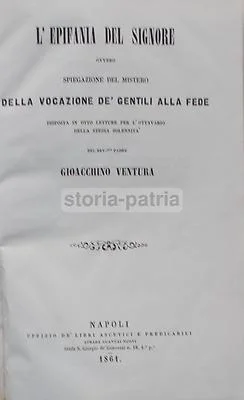
Gioacchino Ventura L'epifania del Signore *ovvero* *Spiegazione del mistero della vocazione de' gentili alla fede* *...* Napoli, Uffizio de' Libri Ascetici e predicabili, 1861 Cm.24, pp.57, legatura antica in mezza pelle (difetti) Interessante edizione antica e d'epoca, pubblicazione a cura del celebre teologo padre Ventura, di origini siciliane, con all'interno otto "letture", *sul mistero della Epifania* *sulla chiamata dei Magi* *i Magi a Gerusalemme* *i Magi alla grotta di Betlemme* *del ministero che Maria ha esercitato nella vocazione dei gentili alla fede* *condotta scambievole di Noemi e di Rut, figura della condotta scambievole di Maria e della chiesa dei gentili* *la benedizione di Noè ai suoi figlioli, profezia e figura dell'ingresso dei gentili alla vera Chiesa* *....* Di interesse culturale, teologico, biblico, bibliografico *rara edizione, attualmente due soli esemplari noti nel sistema bibliotecario nazionale italiano* Discreta conservazione generale, segni e difetti d'uso e d'epoca, sparse fioriture e sgualciture e difetti vari marginali o così come visibili nelle immagini allegate; difetti vari marginali alla legatura. *(le immagini allegate raffigurano alcuni particolari dell'intero volume,* *eventuali ulteriori informazioni a richiesta)* *####* *dal web, wikipedia:* ***Gioacchino Ventura (dei Baroni) di Raulica** (8 December 1792 in [Palermo](https://en.wikipedia.org/wiki/Palermo "Palermo") – 2 August 1861 in [Versailles](https://en.wikipedia.org/wiki/Versailles_\(city\) "Versailles (city)")), was an [Italian](https://en.wikipedia.org/wiki/Italy "Italy") [Roman Catholic](https://en.wikipedia.org/wiki/Roman_Catholicism "Roman Catholicism") pulpit [orator](https://en.wikipedia.org/wiki/Orator "Orator"), patriot, philosopher and writer.* *He entered the [Society of Jesus](https://en.wikipedia.org/wiki/Society_of_Jesus "Society of Jesus") in 1808, and in 1817, when the Society was suppressed in Sicily, joined the [Theatines](https://en.wikipedia.org/wiki/Theatines "Theatines"). Ordained a priest, he distinguished himself as a Catholic journalist and apologist, as a preacher, especially by his "Funeral Oration of [Pius VII](https://en.wikipedia.org/wiki/Pius_VII "Pius VII")" (1823), and as an exponent of the [counter-revolutionary](https://en.wikipedia.org/wiki/Counter-revolutionary "Counter-revolutionary")worldview of [Hughes Felicité Robert de Lamennais](https://en.wikipedia.org/wiki/Hughes_Felicit%C3%A9_Robert_de_Lamennais "Hughes Felicité Robert de Lamennais"), [Joseph de Maistre](https://en.wikipedia.org/wiki/Joseph_de_Maistre "Joseph de Maistre") and [Louis Gabriel Ambroise de Bonald](https://en.wikipedia.org/wiki/Louis_Gabriel_Ambroise_de_Bonald "Louis Gabriel Ambroise de Bonald").* *He was appointed by [Leo XII](https://en.wikipedia.org/wiki/Leo_XII "Leo XII") professor of canon law at the Sapienza, and in 1830 was elected [Superior-General](https://en.wikipedia.org/wiki/Superior-General "Superior-General") of the Theatines. He published his "De methodo philosophandi" in 1828 and "Bellezze della Fede" in 1839. After his generalship (1830-33) he preached in Rome. His eloquence, though somewhat exaggerated and prolix, was vehement and direct, with a noble bearing, a magnificent voice and an affecting delivery, and it won him great renown. In Paris, though not perfectly master of French, he was said to almost rival the famous [Jean-Baptiste Henri Lacordaire](https://en.wikipedia.org/wiki/Jean-Baptiste_Henri_Lacordaire "Jean-Baptiste Henri Lacordaire").* *With the accession of [Pope Pius IX](https://en.wikipedia.org/wiki/Pope_Pius_IX "Pope Pius IX"), Ventura became politically prominent. His "Funeral Oration of O'Connell" (1847) glorified the union of religion and liberty. His eulogy of liberty on the "Morti di Vienna" sounded almost like a diatribe against kings in general. It was put on the [Index of Prohibited Books](https://en.wikipedia.org/wiki/Index_of_Prohibited_Books "Index of Prohibited Books").* *Ventura maintained the lawfulness of the Sicilian Revolution (cfr. his "Sul riconoscimento della Sicilia, etc.", Palermo, 1848; "Menzogne diplomatiche", etc.). His political ideal was an Italian Confederation under the presidency of the pope. During the exile of Pius IX at [Gaeta](https://en.wikipedia.org/wiki/Gaeta "Gaeta"), Ventura's position in Rome was delicate. Though refusing a seat in the Roman Assembly, he advocated the separation of the ecclesiastical and temporal powers, and in the name of the Sicilians recognized the Roman Republic. As commissioner from Sicily, he was present at a controversial politico-religious ceremony in St. Peter's Basilica, but took no active part in the services. He opposed French intervention in behalf of the pope and when Marshal [Oudinot](https://en.wikipedia.org/wiki/Oudinot "Oudinot") attacked Rome, spoke of Pius IX in words which he bitterly regretted.* *On the downfall of the [Triumvirs](https://en.wikipedia.org/wiki/Triumvir "Triumvir") (1849), he went to [Montpellier](https://en.wikipedia.org/wiki/Montpellier "Montpellier") and then to [Paris](https://en.wikipedia.org/wiki/Paris "Paris") (1851). Here he made an ineffectual attempt to convert his former friend de Lamennais. His Conferences at the "Madeleine" etc. were published as "La raison philosophique et la raison catholique" (1852---). In 1857 he gave the Lenten Sermons at the [Tuileries](https://en.wikipedia.org/wiki/Tuileries "Tuileries") before [Napoleon III](https://en.wikipedia.org/wiki/Napoleon_III "Napoleon III"); these appeared as "Le pouvoir politique chrétien".* *Ventura's philosophical views received final expression in "La tradizione e semi-pelagiani della philosophia", "Saggio sull' origine dell' idee", "Philosophie chrétienne" (Paris, 1861). He is a moderate Traditionalist of the [Bonald-Bonnetty School](https://en.wikipedia.org/w/index.php?title=Bonald-Bonnetty_School&action=edit&redlink=1 "Bonald-Bonnetty School (page does not exist)"). Ventura's private life was irreproachable. He remained a loyal Catholic the rest of his life.* *His works were published as: "Opere Complete" (31 volumes, Milan, 1854-64); "Opere Postume", (Venice, 1863).*

Oggetti simili