Fotografia Stereo Nave Da Guerra Retvizan Griffith 1904
Valore stimato —€349.3
Descrizione
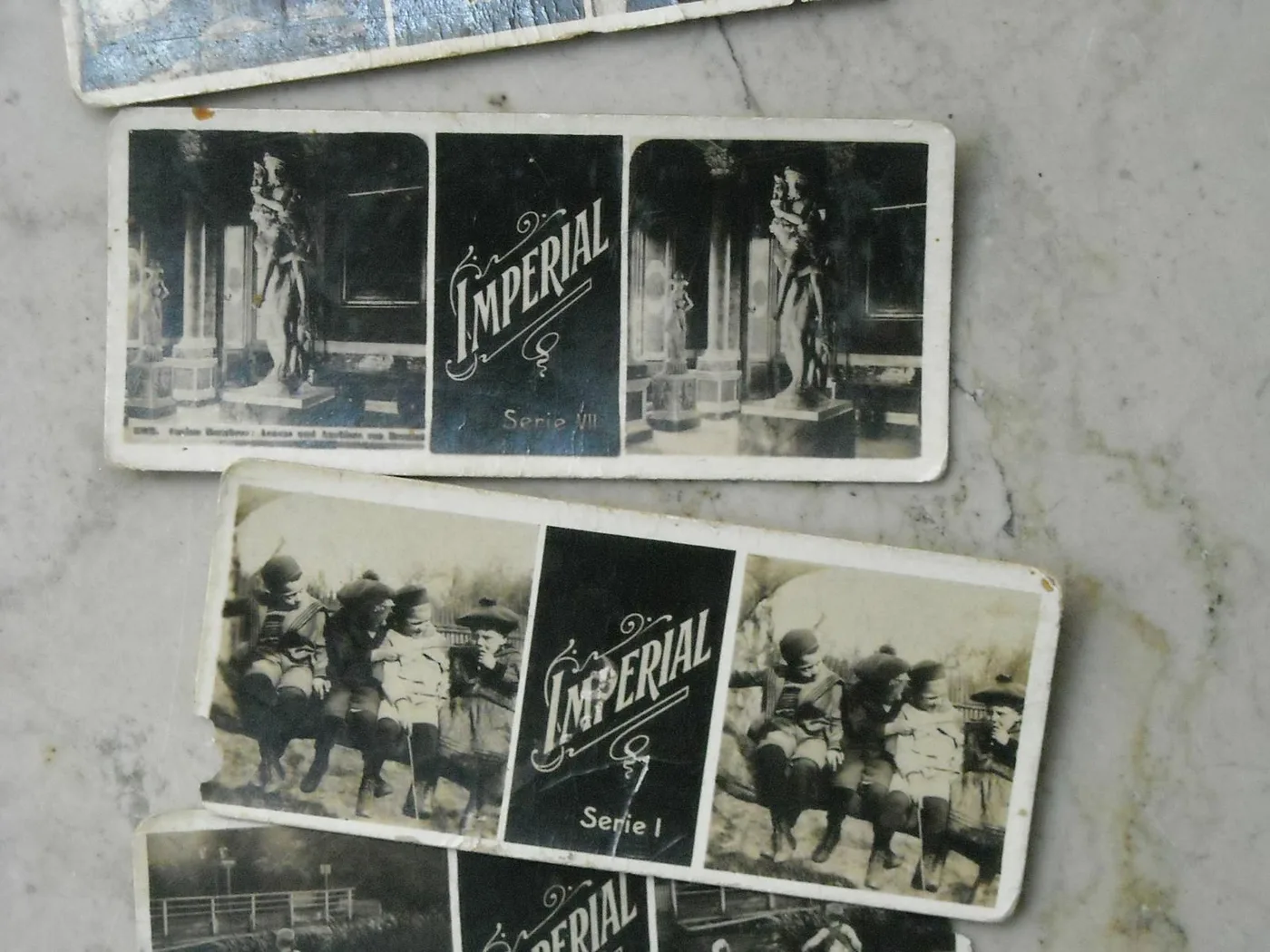
The After Deck of the Russian Battleship "Retvizan" Interessante edizione antica e d'epoca, inusuale stereo-fotografia a cura dello studio fotografico Griffith & Griffith, all'epoca con sedi in America, a Filadelfia, ma anche a Londra e Milano, Chicago e Amburgo; veduta raffigurante una prospettiva di una antica nave russa da guerra, armata di cannoni, e visibili anche alcuni militari o marinari; (la presente stereografia, così come altre eseguite con simile tecnica, offrivano la possibilità di avere una visione quasi tridimensionale, se osservata con il particolare visore); misura circa cm.9x18 (le dimensioni del supporto in cartoncino), circa cm. 15,5x7,5 la sola parte fotografica (incollata sul supporto in cartoncino); fotografia siglata in basso a destra "series of 1904 by George W. Griffith", pertanto esemplare databile al primo '900 (1904 ?) Di interesse militare, fotografico, collezionistico Discreta conservazione generale, segni e difetti d'uso e d'epoca, sparse abrasioni e segni di usura e sgualciture o altri difetti vari marginali e così come visibili nelle immagini allegate; al verso del cartoncino di supporto nessuna scritta impressa; stereo foto meritevole anche di essere inserita sotto passpartout ed incorniciata. (le immagini allegate raffigurano particolari dell'intero oggetto, eventuali ulteriori informazioni a richiesta) ### dal web, wikipedia: For other ships of the same name, see Retvizan (ship). Retvizan at anchor in Japanese service as Hizen. The crew's washing is hanging up to dry. Class overview Name: Retvizan Operators: Russian Navy Preceded by: Potemkin Succeeded by: Tsesarevich Built: 1899–1902 In commission: 1902–1922 Completed: 1 Career (Russia) Name: Retvizan Ordered: 2 May 1898[Note 1] Builder: William Cramp and Sons, Philadelphia Cost: $4,360,000 Yard number: 300 Laid down: 29 July 1899 Launched: 23 October 1900 Commissioned: 23 March 1902 Captured: 2 January 1905 Fate: Sunk by Japanese howitzers in Port Arthur, China, 6 December 1904 Career (Empire of Japan) Name: Hizen Namesake: Hizen Province Acquired: 2 January 1905 Out of service: April 1922 Renamed: Hizen Reclassified: 1 September 1921 as a 1st class coast defence ship Refit: 27 November 1905–November 1908 Struck: 20 September 1923 Fate: Sunk as gunnery target, 25 July 1924 General characteristics Type: Pre-dreadnought battleship Displacement: 12,708 long tons (12,912 t) standard Length: 386 ft 8 in (117.9 m) Beam: 72 ft 2 in (22.0 m) Draft: 25 ft (7.6 m) Installed power: 16,000 ihp (11,931 kW) 24 Niclausse boilers Propulsion: 2 shafts, 2 vertical triple-expansion steam engines Speed: 18 knots (33 km/h; 21 mph) Range: 4,900 nmi (9,100 km; 5,600 mi) at 10 knots (19 km/h; 12 mph) Complement: 28 officers, 722 men Armament: • 2 × twin 12-inch (305 mm) guns • 12 × single 6-inch (152 mm) guns • 20 × single 75-millimetre (3 in) guns • 24 × single 47-millimetre (1.9 in) guns • 6 × single 37-millimetre (1.5 in) guns • 6 × 1 - 15-inch (381 mm) torpedo tubes • 45 mines Armour: Krupp armour Belt: 9 inches (229 mm) Deck: 2–3 inches (51–76 mm) Barbettes: 4–8 inches (102–203 mm) Turrets: 9 inches (229 mm) Conning tower: 10 inches (254 mm) Bulkheads: 7 inches (178 mm) Retvizan (Russian: Ретвизан) was a pre-dreadnought battleship built before the Russo-Japanese War of 1904–05 for the Imperial Russian Navy. She was built by the American William Cramp and Sons because Russian shipyards were already at full capacity. Named after a Swedish ship of the line that was captured during the battle of Vyborg Bay in 1790 (Swedish: Rättvisan, meaning both fairness and justice), Retvizan was briefly assigned to the Baltic Fleet, but was transferred to the Far East in 1902. The ship was torpedoed during the Japanese surprise attack on Port Arthur during the night of 8/9 February 1904 and grounded in the harbour entrance when she attempted to take refuge inside, as her draft had significantly deepened from the amount of water she had taken aboard after the torpedo hit. She was refloated and repaired in time to join the rest of the 1st Pacific Squadron when they attempted to reach Vladivostok through the Japanese blockade on 10 August. The Japanese battle fleet engaged them again in the Battle of the Yellow Sea, forcing most of the Russian ships to return to Port Arthur after their squadron commander was killed and his flagship damaged. Retvizan was sunk by Japanese howitzers in December after the Japanese gained control of the heights around the harbour. The Japanese raised and repaired Retvizan after Port Arthur surrendered in January 1905. She was commissioned into the Imperial Japanese Navy as Hizen (肥前) in 1908. Based in Sasebo when the Japanese declared war on Germany in 1914, the ship was sent to reinforce the weak British squadron off British Columbia, but diverted to Hawaii after reports of a German gunboat there. Hizen was unsuccessfully sent to search for other German ships after the Americans interned the gunboat in November. After World War I she supported the Japanese intervention in the Russian Civil War and was disarmed in 1922 in accordance with the terms of the Washington Naval Treaty. The ship was sunk as a gunnery target in 1924. Tsar Nicholas II had desired a warm-water port on the Pacific since his accession to the throne in 1894. He achieved this ambition in March 1898 when Russia signed a 25-year lease for Port Arthur and the Liaotung Peninsula with China. Japan had previously forced China to sign over the port and its surrounding territory as part of the treaty that concluded the First Sino-Japanese War of 1894–95, but the Triple Intervention of France, Russia, and Germany forced them to return the port in exchange for a sizeable increase in the indemnity paid by the Chinese. Japan invested much of the indemnity money in expanding its fleet, while Russia began a major building programme ("For the Needs of the Far East") to defend its newly acquired port.[1] Russian shipyards were already at maximum capacity so the Naval Ministry decided to order ships from abroad. Charles Henry Cramp, the owner and son of the founder of William Cramp and Sons in Philadelphia, had a relationship with the Imperial Russian Navy dating back to the late 1870s when his firm built the auxiliary cruisers Afrika, Asia, Europa and Zabiiaka. Cramp also repaired several Russian warships visiting America in 1893, and he cultivated the contacts he made in the Russian Navy throughout the 1890s. As such, he was ideally positioned to offer to build a battleship for the Russians in his shipyard when they began to look abroad.[2] Design and description[edit] Plan and right elevation line drawing showing the armour (shaded areas) in the elevation view and the armament in the plan view Preliminary design work on a battleship intended to equal the latest Japanese ships was begun over the winter of 1897–98 by the Naval Technical Committee although the displacement was limited to 12,000 long tons (12,193 t) for economic reasons. The basic design was that of the Peresvet class with its speed increased to 18 knots (33 km/h; 21 mph) using only two shafts and its steaming range increased to 5,000 nautical miles (9,300 km; 5,800 mi) at 10 knots (19 km/h; 12 mph). The Naval Ministry intended to conduct an international design competition with the ships being built abroad as the Baltic shipyards were at full capacity already.[3] Cramp's contacts kept him informed of the Russians' intentions and he sailed to Saint Petersburg to offer his services and design expertise in March 1898. Initially Cramp offered American designs to the Russians, including an updated version of the USS Iowa as it was a relatively close match for the Russian specification, but the Russians preferred their own designs. Both sides compromised and the final design was based on the Russian battleship Potemkin. The new ship had four fewer 6-inch (152 mm) guns, but twice the coal capacity for improved range and a longer, slightly narrower hull for more speed. The contract was signed on 23 April 1898 for a price of $4,360,000. The protected cruiser Varyag was ordered at the same time for $2,138,000.[4] Cramp later designed the Maine-class battleships built for the US Navy, based on the Retvizan. They had a lower quarterdeck, two more six-inch guns and a slightly thicker belt.[5] Retvizan was 382 feet 3 inches (116.5 m) long at the waterline and 386 feet 8 inches (117.9 m) long overall. She had a beam of 72 feet 2 inches (22.0 m) and a draft of 25 feet (7.6 m). The ship displaced 12,780 long tons (12,985 t) at normal load. Her hull was subdivided by fourteen transverse watertight bulkheads; in addition a longitudinal centreline bulkhead divided the engine room. Retvizan had a complete double bottom that extended up the side to the lower edge of the armour deck. She had a metacentric height of 3 feet 2 inches (1.0 m). Her crew consisted of 23 officers and 722 enlisted men.[6] Retvizan had two three-cylinder vertical triple-expansion steam engines with a total designed output of 16,000 indicated horsepower (11,931 kW). The Russian Navy preferred to use Belleville boilers, but Cramp pressed for Niclausse boilers, not least because he was the American agent for them, and was supported by the General Admiral Grand Duke Alexei Alexandrovich. Twenty-four Niclausse-type boilers provided steam to the engines at a working pressure of 18 standard atmospheres (1,824 kPa; 265 psi). On sea trials, the engines produced 17,111 ihp (12,760 kW) and a top speed of 17.99 knots (33.32 km/h; 20.70 mph), just under the contract speed of 18 knots. Not surprisingly, Cramp claimed that she reached 18.01 knots to avoid contractual penalties. Following Retvizan's arrival in Russia, the propeller pitch was adjusted and she exceeded 18 knots. She carried a normal load of 1,016 long tons (1,032 t) of coal that provided a range of 4,900 nautical miles (9,100 km; 5,600 mi) at a speed of 10 knots (19 km/h; 12 mph) and a maximum load of 2,000 long tons (2,000 t) that gave 8,000 nautical miles (15,000 km; 9,200 mi) at the same speed.[7] Retvizan's armament was built by the Obukhov Works in Saint Petersburg and shipped to America for installation. The main armament consisted of two pairs of 12-inch 40-calibre guns mounted in French-style electrically-operated centre-pivot twin turrets fore and aft. These guns had a maximum elevation of +15° and could depress to -5°. The ship carried 77 rounds per gun and the guns could fire one round every 80 to 90 seconds. They fired a 730-pound (330 kg) shell at a muzzle velocity of 2,592 ft/s (790 m/s) to a range of 12,000 yards (11,000 m).[8] Eight of the twelve 45-calibre 6-inch Canet Pattern 1892 quick-firing (QF) guns were mounted in casemates on the main deck while four were mounted on the upper deck.[8] They fired shells that weighed 91.3 lb (41.4 kg) with a muzzle velocity of 2,610 ft/s (800 m/s).[9] They had a maximum range of around 12,000 yards (11,000 m) and could fire three to five rounds per minute. The guns were provided with 200 rounds each.[8] The ship carried many smaller guns to defend itself against attack by torpedo boats. The largest of these were twenty QF 75-millimeter (3.0 in) Canet Pattern 1892 guns. Fourteen of these were in embrasures on the main deck and six were mounted on the upper deck, between the six-inch casemates. Each gun was provided with 325 rounds.[10] They fired an 11-pound (4.9 kg) shell at a muzzle velocity of 2,700 ft/s (820 m/s) to a maximum range of 7,005 yards (6,405 m).[11] The rate of fire was between twelve and fifteen rounds per minute. A total of twenty-four 47-millimeter (1.9 in) Hotchkiss guns were carried; four in each fighting top and eight at each end of the superstructure.[12] They fired a 3.3-pound (1.5 kg) shell at a muzzle velocity of 2,100 ft/s (650 m/s).[13] Six 37-millimeter (1.5 in) Hotchkiss guns were mounted in the bridge wings. They fired a 1.1-pound (0.50 kg) shell at a muzzle velocity of 1,540 ft/s (470 m/s).[14] Retvizan carried six 15-inch (381 mm) torpedo tubes. Four were above water, one each in the bow and stern and the aft pair of broadside tubes; the forward broadside tubes were underwater. A total of 17 torpedoes were carried. The ship was designed to carry two second-class torpedo boats each equipped with a single torpedo tube and a small quick-firing gun. The ship could also carry 45 mines.[12] The ship was fitted with Liuzhol stadiametric rangefinders that used the angle between two vertical points on an enemy ship, usually the waterline and the crow's nest, to estimate the range. The gunnery officer consulted his references to get the range and calculated the proper elevation and deflection required to hit the target. He transmitted his commands via a Geisler electro-mechanical fire-control transmission system to each gun or turret.[12][15] The total weight of the Krupp armour was 3,300 long tons (3,353 t) or 25.8% of the displacement. The armour was mostly made in the United States, although a contract was let for deck armour from Russia on 6 January 1899.[16] The main waterline belt had a maximum thickness of 9 inches (229 mm) and tapered to 5 inches (127 mm) thick at its lower edge. It was 256 feet (78.0 m) long and 7 feet (2.1 m) high, of which about 3 feet (0.9 m) was above the waterline. The 6-inch upper belt was as long as the main belt and was 7 feet 6 inches (2.3 m) high. Armour plates 2 inches (51 mm) thick protected the ends of the ship to a height equal to that of the main and upper belts combined. Bulkheads 7 inches (177.8 mm) thick provided transverse protection for the ship's vitals. The