The Moon And Sixpence Somerset Maugham 1919 Edizione Modern Library

Valore stimato —349.3

Descrizione

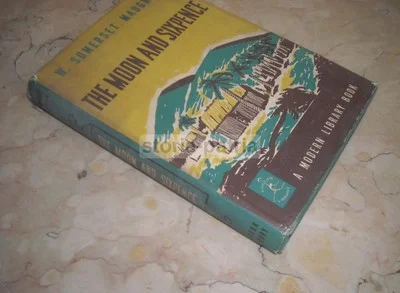
**W. SOMERSET MAUGHAM**  **THE MOON AND SIXPENCE** New York, The Modern Library, (copyright 1919, by George H. Doran Company) Cm.18, pp.314+ catalogo editoriale, telato editoriale con sovraccopertina figurata (difetti) **Interessante edizione d'epoca,** **volume apparso a cura della casa editrice newyorkese The Modern Library, la quale pubblica in fondo al volume anche un elenco di altri suoi libri, in pratica una appendice pubblicitaria editoriale, come pure un altro lungo elenchi di suoi libri è pubblicato all'interno della sovraccopertina;** **opera narrativa in lingua inglese, con trattazione che riferisce aspetti della biografia del noto artista Gauguin;** ***volume impreziosito da una sovraccopertina figurata che illustra un paesaggio forse africano, con palme e capanne e indigeni, forse immagine riferita all'argomentazione esposta nel testo (illustrazione probabilmente cromolitografica, forse anche firmata essendo visibile un piccolo nome stampato in basso al centro ma poco leggibile).*** DI INTERESSE CULTURALE, LETTERARIO, ARTISTICO, ANTROPOLOGICO, BIBLIOGRAFICO Discreta conservazione generale, segni e difetti d'uso e d'epoca, difetti vari marginali e così come visibili nelle immagini allegate; volume provvisto di sovraccopertina figurata, sgualciture e strappetti e difetti vari marginali alle copertine e alla sovraccopertina. *(le immagini allegate raffigurano alcuni particolari dell'intero volume, eventuali ulteriori informazioni a richiesta)* *###* *dal web: wikipedia* ***La luna e sei soldi** (The Moon and Sixpence) è un romanzo di [William Somerset Maugham](https://it.wikipedia.org/wiki/William_Somerset_Maugham "William Somerset Maugham"), scritto nel [1919](https://it.wikipedia.org/wiki/1919 "1919"). Il romanzo suscitò scalpore per i suoi toni "ribelli" rispetto ai libri che l'autore solitamente proponeva. Del romanzo esiste anche una trasposizione cinematografica, [La luna e sei soldi](https://it.wikipedia.org/wiki/La_luna_e_sei_soldi_\(film\) "La luna e sei soldi (film)"), del [1942](https://it.wikipedia.org/wiki/1942 "1942"), diretta da [Albert Lewin](https://it.wikipedia.org/w/index.php?title=Albert_Lewin&action=edit&redlink=1 "Albert Lewin (la pagina non esiste)").* *Mascherata dietro l'assurda vita del protagonista, l'autore propone la biografia del pittore [Paul Gauguin](https://it.wikipedia.org/wiki/Paul_Gauguin "Paul Gauguin") rivisitata dalla fantasia dello scrittore il quale la intreccia con la vita del protagonista (che è l'autore narrante). È il racconto della vita di un artista che si scopre tale; ha qualcosa di strano, di diverso che lo fa sentire al di fuori e al di sopra delle norme della vita sociale, familiare, lavorativa, in cui era fino ad allora inserito. È un qualcosa di viscerale, primitivo, eppure "spirituale" che cerca drammaticamente le forme della sua espressione. L'autore riesce a far cogliere tutto il fascino, a volte perverso, che emana dal demone dell'arte che pone chi ne è posseduto "al di là del bene e del male". Quindi non si tratta di una vera e propria biografia romanzata, ma di una interpretazione quasi trasfigurata della vita del pittore francese. Una vera e propria storia anche laddove il dato biografico è stato rielaborato con la fantasia.* *###* *This article is about the novel. For the film adaptation, see [The Moon and Sixpence (film)](https://en.wikipedia.org/wiki/The_Moon_and_Sixpence_\(film\) "The Moon and Sixpence (film)").* *** The Moon and Sixpence** is a novel by [W Somerset Maugham](https://en.wikipedia.org/wiki/W_Somerset_Maugham "W Somerset Maugham"), told in episodic form by a first-person narrator, in a series of glimpses into the mind and soul of the central character Charles Strickland, a middle-aged English stockbroker, who abandons his wife and children abruptly to pursue his desire to become an artist. The story is said to be loosely based on the life of the painter [Paul Gauguin](https://en.wikipedia.org/wiki/Paul_Gauguin "Paul Gauguin").* *The novel is written largely from the point of view of the narrator, who is first introduced to Strickland through the latter's wife. Strickland strikes him (the narrator) as unremarkable. Certain chapters entirely comprise stories or narrations of others, which the narrator recalls from memory (selectively editing or elaborating on certain aspects of dialogue, particularly Strickland's, as Strickland is said by the narrator to be limited in his use of verbiage and tended to use gestures in his expression).* *Strickland is a well-off, middle-class stockbroker in London sometime in late 19th or early 20th century. Early in the novel, he leaves his wife and children and goes to Paris. He lives a destitute but defiantly content life there as an artist (specifically a painter), lodging in run-down hotels and falling prey to both illness and hunger. Strickland, in his drive to express through his art what appears to continually possess and compel him on the inside, cares nothing for physical discomfort and is indifferent to his surroundings. He is generously supported, while in Paris, by a commercially successful but hackneyed Dutch painter, Dirk Stroeve, a friend of the narrator's, who immediately recognises Strickland's genius. After helping Strickland recover from a life-threatening condition, Stroeve is repaid by having his wife, Blanche, abandon him for Strickland. Strickland later discards the wife; all he really sought from Blanche was a model to paint, not serious companionship, and it is hinted in the novel's dialogue that he indicated this to her and she took the risk anyway. Blanche then commits suicide – yet another human casualty in Strickland's single-minded pursuit of art and beauty; the first ones being his own established life and those of his wife and children.* *After the Paris episode, the story continues in [Tahiti](https://en.wikipedia.org/wiki/Tahiti "Tahiti"). Strickland has already died, and the narrator attempts to piece together his life there from recollections of others. He finds that Strickland had taken up a native woman, had two children by her, one of whom dies, and started painting profusely. We learn that Strickland had settled for a short while in the French port of [Marseilles](https://en.wikipedia.org/wiki/Marseilles "Marseilles") before traveling to Tahiti, where he lived for a few years before finally dying of [leprosy](https://en.wikipedia.org/wiki/Leprosy "Leprosy"). Strickland left behind numerous paintings, but his [magnum opus](https://en.wikipedia.org/wiki/Masterpiece "Masterpiece"), which he painted on the walls of his hut before losing his sight to leprosy, was burnt after his death by his wife per his dying orders.* *The inspiration for this story, [Gauguin](https://en.wikipedia.org/wiki/Paul_Gauguin "Paul Gauguin"), is considered to be the founder of [primitivism](https://en.wikipedia.org/wiki/Primitivism "Primitivism") in art. The main differences between Gauguin and Strickland are that Gauguin was French rather than English, and whilst Maugham describes the character of Strickland as being largely ignorant of his contemporaries in Modern art, as well as largely ignorant of other artists in general, [Gauguin](https://en.wikipedia.org/wiki/Paul_Gauguin "Paul Gauguin") himself was well acquainted with and exhibited with the Impressionists in the 1880s and lived for a while with [Van Gogh](https://en.wikipedia.org/wiki/Van_Gogh "Van Gogh") in southern France.* *According to some sources, the title, the meaning of which is not explicitly revealed in the book, was taken from a review of [Of Human Bondage](https://en.wikipedia.org/wiki/Of_Human_Bondage "Of Human Bondage") in which the novel's[protagonist](https://en.wikipedia.org/wiki/Protagonist "Protagonist"), Philip Carey, is described as "so busy yearning for the moon that he never saw the sixpence at his feet."[\[1\]](https://en.wikipedia.org/wiki/The_Moon_and_Sixpence#cite_note-1) According to a 1956 letter from Maugham, "If you look on the ground in search of a sixpence, you don't look up, and so miss the moon."* *The book was made into a [film of the same name](https://en.wikipedia.org/wiki/The_Moon_and_Sixpence_\(film\) "The Moon and Sixpence (film)") directed and written by [Albert Lewin](https://en.wikipedia.org/wiki/Albert_Lewin "Albert Lewin"). Released in 1942, the film stars [George Sanders](https://en.wikipedia.org/wiki/George_Sanders "George Sanders") as Charles Strickland.* *The novel served as the basis for an opera, also titled The Moon and Sixpence, by [John Gardner](https://en.wikipedia.org/wiki/John_Gardner_\(composer\) "John Gardner (composer)") to a libretto by [Patrick Terry](https://en.wikipedia.org/w/index.php?title=Patrick_Terry&action=edit&redlink=1 "Patrick Terry (page does not exist)"); it was premiered at [Sadlers Wells](https://en.wikipedia.org/wiki/Sadlers_Wells "Sadlers Wells") in 1957.[\[2\]](https://en.wikipedia.org/wiki/The_Moon_and_Sixpence#cite_note-2)* *Writer S Lee Pogostin adapted it for American TV in 1959. This production starred [Laurence Olivier](https://en.wikipedia.org/wiki/Laurence_Olivier "Laurence Olivier"), with [Hume Cronyn](https://en.wikipedia.org/wiki/Hume_Cronyn "Hume Cronyn") and [Jessica Tandy](https://en.wikipedia.org/wiki/Jessica_Tandy "Jessica Tandy") in supporting roles.* *In the opening scene of [François Truffaut](https://en.wikipedia.org/wiki/Fran%C3%A7ois_Truffaut "François Truffaut")'s cinematic adaptation of [Fahrenheit 451](https://en.wikipedia.org/wiki/Fahrenheit_451_\(1966_film\) "Fahrenheit 451 (1966 film)"), several firemen are preparing books for burning. In the crowd of onlookers is a little boy who picks up one of the books and thumbs through it before his father takes it from him and throws it on the pile with the rest. That book is The Moon and Sixpence.* *The book was mentioned in [Agatha Christie](https://en.wikipedia.org/wiki/Agatha_Christie "Agatha Christie")'s mystery ([Hercule Poirot](https://en.wikipedia.org/wiki/Hercule_Poirot "Hercule Poirot") series) novel [Five Little Pigs](https://en.wikipedia.org/wiki/Five_Little_Pigs "Five Little Pigs"), when Poirot asks one of the suspects (Angela Warren) if she read the book at the time the crime was committed.* *The book was also mentioned frequently in [Stephen King](https://en.wikipedia.org/wiki/Stephen_King "Stephen King")'s 1998 novel [Bag of Bones](https://en.wikipedia.org/wiki/Bag_of_Bones "Bag of Bones").* *[Ray Noble](https://en.wikipedia.org/wiki/Ray_Noble "Ray Noble")'s 1932 dance band hit "We've Got the Moon and Sixpence", sung by [Al Bowlly](https://en.wikipedia.org/wiki/Al_Bowlly "Al Bowlly"), takes its name from the book.* *[Jack Kerouac](https://en.wikipedia.org/wiki/Jack_Kerouac "Jack Kerouac") mentions the book in his 1958 novella [The Subterraneans](https://en.wikipedia.org/wiki/The_Subterraneans "The Subterraneans"). (dal web, wikipedia)*

Oggetti simili